

Tourism Marketing
AI Innovations
Business Growth

Live chat is one of the most powerful tools a tourism business can add to its website — but only when it's used well. More travellers are embracing chat over phone and email because it's fast, easy, and works in any situation: international visitors avoid long-distance call costs, and mobile users can get answers in busy places without struggling to hear. The catch is that chat demands speed. Take too long to respond and visitors move on. Here's how to get it right.
Timing matters. A good AI Chatbot gives visitors a chance to settle in before offering support — just like a good in-store assistant.
For most tourism websites, the ideal trigger is after 10 seconds on the page, or once someone has scrolled to the bottom. Too early feels intrusive; too late misses the moment.
The words, visuals, and tone of your first chat message set the tone for the whole interaction. Aim to inform rather than sell — a subtle, helpful offer of assistance lands far better than an enthusiastic sales pitch. Keep it warm, on-brand, and low-pressure.
On e-commerce and B2B sites, collecting email addresses before starting a chat is common practice. For tourism, it's counterproductive.
Most travellers are making a one-off, time-sensitive decision — they're not interested in being nurtured through a long sales funnel. Asking for an email before they can even ask a question creates unnecessary friction. Yonder skips this step entirely, making it as easy as possible for visitors to get the help they need immediately.
Live chat should feel effortless. If it's complicated or requires multiple steps before a visitor can ask their question, they'll give up and leave.
The simpler the entry point, the more conversations you'll have — and the more bookings you'll win.
Address the questions visitors are likely to have before they even ask. A whitewater rafting company, for example, might proactively mention water temperature in winter — because many potential customers are silently wondering whether it'll be freezing cold.
Getting ahead of common concerns builds confidence and removes barriers to booking. Yonder's AI Chatbot lets you configure these anticipatory messages for different pages and seasons.
Take the below approach from a whitewater rafting company.
In winter, many would-be rafters are worried about freezing cold water – but they’ll be feeling a whole lot warmer about the idea after reading this message:
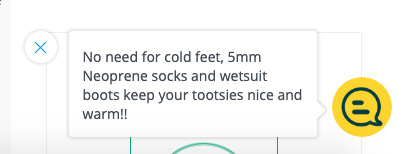
The rafting company anticipated their customer’s needs and provided a solution, without being asked. Now that’s customer service.
Live chat is, by definition, live.
Visitors expect instant responses whether they're a local or booking from overseas. One operator we know of took nine minutes to respond — and that was already too late. Yonder handles this by automating the majority of responses from day one, with all your FAQs compiled and pre-answered before your chatbot goes live.
For questions that fall outside automated responses, a mobile app and staff roster for outside office hours keeps response times tight. Over 40% of chat conversations happen outside business hours — making 24/7 coverage essential.
Typing a comprehensive reply can take 2–5 minutes. In that time, your visitor may have moved on.
Start with a quick acknowledgement — "Hi there, I'd love to help with that!" — to let them know someone is engaged, then follow up with the answer.
Chat is conversational by nature. Short messages, asked questions, brief answers — not email-style paragraphs.
Automated responses are only valuable when the AI is smart enough to genuinely understand what's being asked and reply with something relevant.
Poorly executed automation frustrates visitors and damages trust. Done well, it can actually outperform human responses — with consistent quality, no spelling errors, and rich replies that include images and links.
Yonder customers typically find 50–70% of enquiries are handled automatically, freeing your team for the conversations that need a human. See how Yonder's AI Chatbot handles automation.
A few benefits of automated answers (when done well):
Even with strong automation, your staff will still handle some conversations. Make sure they're comfortable with the chat tool and understand how to deliver the same quality of service they'd give over the phone or by email. A short internal training session before going live makes a real difference to consistency.
Not all live chat software is built the same — and the wrong tool for your industry can cost you bookings rather than win them. Tourism has unique needs: last-minute bookers, international visitors, complex product questions, and after-hours enquiries. One Yonder customer switched from a generic live chat provider and saw enquiries jump from 3 per month to 100 per month.
Yonder is purpose-built for tourism operators, combining AI chat and live chat in a single platform with deep integrations into your booking system.
Book a demo to see what it could do for your business 👇