
Review Generation
Business Growth
Customer Service
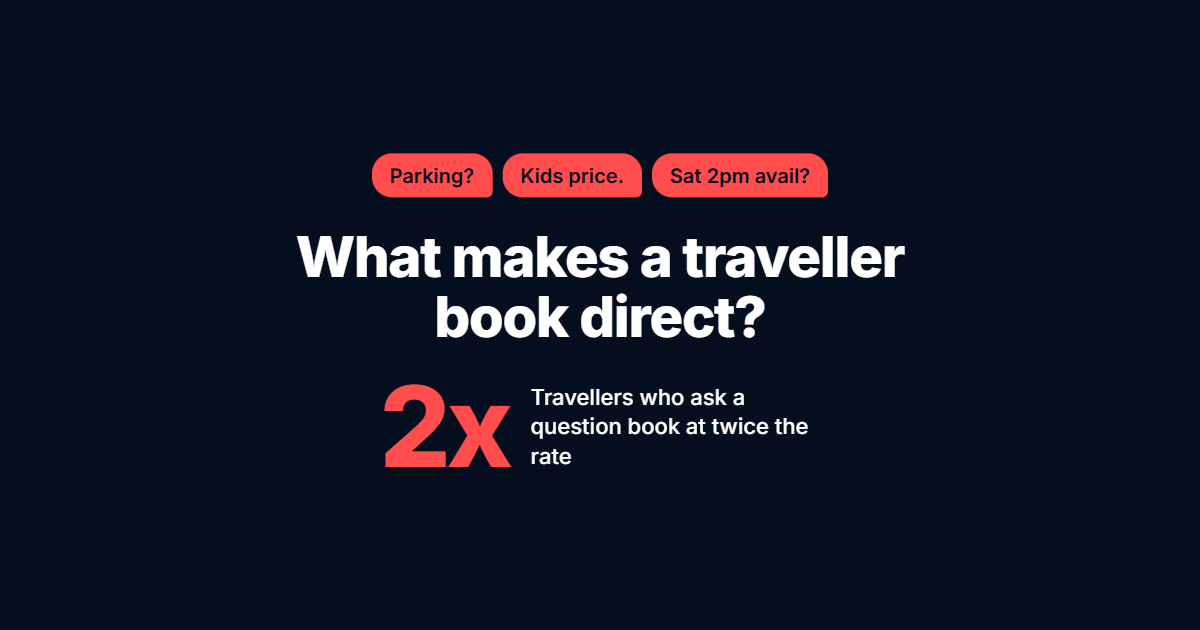

We analysed a year of real pre-booking questions from tour, activity and attraction websites. The travellers who asked a question booked at about twice the rate of those who didn't. Here's what they asked, when they asked it, and 10 things to check on your own site this week.
Every operator knows the feeling. A traveller finds you on Google, clicks through to your website, looks around for a minute, then books the exact same tour on Viator or GetYourGuide. You still get the booking. You just hand over 20 to 30% of it in commission.
That's becoming the norm. Arival's latest operator survey found OTAs accounted for 37% of experience bookings in 2025, up from 28% in 2023. In the last year alone, the share booked on operators' own websites fell from 29% to 25%.
So what makes a traveller who is already on your website stay there and finish the booking? We went looking for the answer in the questions travellers ask right before they book: a year of anonymised chat conversations from tour, activity and attraction websites across the US, Australia and New Zealand, set against those websites' own booking data. No names, no personal details, just the questions and what happened next.
The short version: our data points to something simpler than OTA loyalty. Often, a traveller has one unanswered question, and the OTA tab looks like the faster way to get it answered.
We compared website sessions where the visitor used chat with sessions where they didn't, across 101 tour, activity and attraction operators over twelve months.
At the typical operator, visitors who asked a question booked at about twice the rate of visitors who didn't. Across all 101 operators combined, the gap was even wider: 4.6% of chat sessions ended in a booking, against 2.0% of the rest. Nearly 9 in 10 operators saw chatting visitors convert better, and their orders were slightly larger too.
It's worth being clear about what that means. Chat doesn't magically create buying intent. The people who ask questions are already further along: they're picking a date, counting heads and reading the fine print. The question is the last step before checkout. Answer it well and the booking happens on your website. Leave it hanging and the traveller goes looking for the answer somewhere else, usually somewhere with its own Book button.
Travellers say the same thing. In Arival's research into how people choose between experiences, "the ability to talk to someone" ranks third among the four things travellers look for most. An OTA can't answer a detailed question about your tour. You can.
Visitors who asked a question booked at about twice the rate of those who didn't. The question isn't a distraction from the sale. It's the final step of it.
Availability leads by a wide margin. By the time a traveller types a question, they usually know what they want. They're checking whether it works for them: the date, the location, the group, the price and the rules.
| What they ask about | Share of customer messages | What they're really asking |
|---|---|---|
| Availability and dates | 13% | "Can I go when I want to go?" |
| Meeting point, address, parking, pick-up | 8% | "Can I actually get there?" |
| Groups, private bookings and events | 5% | "Can you handle all of us?" |
| Price and fees | 4% | "What will this really cost me?" |
| Hours and duration | 4% | "Does it fit my day?" |
| What to bring and wear, food and drink | 4% | "Will I be comfortable?" |
| Ages and kids | 4% | "Can my family come?" |
| Discounts, promo codes and concessions | 3% | "Am I getting the best deal?" |
| Cancellation, refunds and rescheduling | 3% | "What if my plans change?" |
| Payment, deposits, waivers and add-ons | 3% | "Is there anything else before I pay?" |
| Health, fitness and accessibility | 2% | "Can I physically do this?" |
| Weather | 2% | "What if it rains?" |
| Pets | 1.5% | "Can the dog come?" |
A message can touch more than one topic. The rest are greetings, follow-ups, questions about existing bookings and requests to speak to someone.
Two things stand out. First, logistics questions (where, when, what to bring) together outnumber price and fee questions several times over. Travellers aren't only shopping on price. They're trying to picture the day. Second, the "who's allowed" cluster of ages, kids, fitness and accessibility is bigger than you might expect, and "family friendly" doesn't answer any of it.
Not every pre-booking question is equal. Some, like "is there parking?", have one answer that fits every traveller. Others depend on the specifics: the exact total for two adults and a child on a Saturday, whether a promo code works alongside a family rate, or what happens to a deposit if a storm rolls in. Those answers usually live in the booking system, the fine print or a staff member's head, not on the website.
When we compared which topics most often needed details beyond what's typically published on a product page or FAQ, four came out on top:
Logistics topics such as pets, group sizes, what to bring and where to go were the easiest to answer from published information. That makes sense: where to park has one answer for everyone. What the day will cost and what happens if plans change depend on who's booking, when and how, which makes them much harder to spell out on a page.
That matters because money and risk are exactly what OTAs standardise: a price shown up front, a free cancellation badge, a wall of reviews and a checkout that already has the traveller's card saved. When your website leaves someone unsure about the total price or the refund rules, the OTA listing becomes the easiest place to find out.
Wider ecommerce research points the same way. Baymard Institute's checkout research finds that among US online shoppers who abandoned a checkout (leaving aside those who were just browsing), 40% left because extra costs such as taxes and fees were too high, 12% because they couldn't see the total cost up front, and 13% because the returns policy wasn't good enough. For an experience, your cancellation policy is your returns policy.
Where to park has one answer for everyone. The full cost and what happens if plans change usually don't. Those are exactly the answers an OTA listing makes easy to find.
Pre-booking questions don't keep office hours. In operators' local time:
And the people asking aren't planning months ahead. When travellers checked availability through chat, the median date they asked about was three days away. 22% wanted the same day, 41% wanted today or tomorrow, and nearly two thirds wanted a date within the next week.
Arival's traveller research finds that one in five tour bookers still buy their tickets on the day of the experience. It also matches what we see on the phone: in our research into AI-answered calls, most callers who went on to book did so within an hour of hanging up.
Put those together and the maths is simple. A traveller who messages at 9pm on Saturday about tomorrow morning can't wait until your office opens on Monday. By then they've booked, probably on a platform that answered instantly. Zendesk's 2026 CX Trends research found 74% of consumers now expect round-the-clock service.
More than half of pre-booking conversations happen outside weekday office hours, and two in five travellers checking availability want today or tomorrow. An answer in the morning is often an answer too late.
The typical pre-booking message is five words long. "Parking?" "Kids price." "Sat 2pm avail." These are people on their phones, often half-distracted, looking for the fastest path to a yes or no.
That has two practical consequences. Your FAQ headings should look like the questions people actually type, not like a legal document. And every answer, wherever it lives, should lead with the answer: "Yes, free parking on site" beats a paragraph that gets there eventually.
Open your website on your phone, pick your best-selling product, and work through this list as if you were a traveller with one question and five minutes.
Check: on your most popular product page, can you work out the total for two adults and one child, including taxes and fees, without clicking Book?
Fix: list prices by traveller type (adult, child, senior, student, local, group) and show any booking, fuel or park fees on the page, not at the last step.
Check: can a traveller find out what happens if it rains, or if they need to change dates, within one scroll of the booking calendar?
Fix: add a two-line, plain-English summary beside the calendar, such as "Free cancellation up to 24 hours before. If we cancel for weather, choose a full refund or a new date." Link the full terms underneath. If your direct policy is more flexible than your OTA listing, say so.
Check: does your site say why booking direct is better than booking the same tour elsewhere?
Fix: offer something an OTA can't. A best-price promise, free date changes, a small add-on, or simply "book direct and deal with the people who run the tour." Travellers often assume the OTA has the best price. Tell them otherwise.
Check: does your page say "family friendly", or does it say "ages 5 and up, under 12s with an adult, maximum weight 250 lb (113 kg)"?
Fix: spell out age minimums, infant rules, weight limits, fitness level and accessibility on every product page.
Check: are the address, a map link, parking and check-in time on the product page and in the confirmation email?
Fix: add a short "Getting here" block to every product page. It's the second most common pre-booking question.
Check: can a mobile visitor see live availability without scrolling? When a time sells out, does the page offer the next best option?
Fix: place your booking calendar high on the page and show alternative times or dates for sold-out slots, so "sold out" doesn't become "go check the OTA".
Check: is it obvious whether seniors, students, military, locals or groups get a different rate?
Fix: list your concessions plainly. If you don't discount, say so. It stops travellers leaving to hunt for a code that doesn't exist.
Check: does a group of 12, a school or a corporate team know exactly how to book or get a quote?
Fix: state your group size limits, a "from" price for private bookings, and how quickly you reply to quote requests.
Check: tonight, send your own business a question through your website chat, contact form, social inbox and phone. How long until you get a useful answer?
Fix: make sure after-hours questions get an immediate, accurate answer with a booking link. That might be an AI chat or voice agent, or at the very least an auto-reply that links to your FAQ and booking page.
Check: pull last month's chat transcripts, emails and call notes. Which questions came up that your website doesn't answer?
Fix: add each answer to the relevant product page or FAQ, worded the way travellers ask it. Then check that your OTA listings match your website, so anyone comparing the two finds the same price and the same policies.
Often, travellers don't abandon an operator's website because they love OTAs. They abandon it because they had a question about the price, the rules, the date or the meeting point, and the OTA listing looked like the quicker way to an answer.
Close those gaps on your own pages, answer quickly at any hour, and the booking stays with you, along with the 20 to 30% you'd otherwise pay to get it.
Answering pre-booking questions instantly, day or night, with a booking link at the end of every answer is exactly what Yonder's AI chat and voice agents are built for. But most of the list above starts with your own website, and you can fix it this week.
Book a demo to see how Yonder answers your travellers' questions at any hour, with a booking link in every answer.
Often because the OTA makes the decision easier, not because they prefer it. OTAs show price, cancellation terms and reviews in the same place on every listing, and many travellers already have an account and a saved card. If an operator's own website leaves a question unanswered, the OTA becomes the quickest route to a confident booking.
Availability is the most common by a wide margin. After that come the meeting point and parking, group and private bookings, price, hours and duration, what to bring, and age limits for kids. Cancellation, discounts, payment, fitness and accessibility, weather and pets round out the list.
Yes. At the typical operator in our data, website visitors who asked a question in chat booked at about twice the rate of visitors who didn't. People who ask questions are usually close to a decision, which is why a fast, accurate answer matters so much.
Mostly when the operator is closed. More than half of chat conversations start outside weekday business hours, and about 1 in 5 start between 8pm and 6am. Most travellers checking availability want a date within the next week.
Show the full price before checkout, put a plain-English cancellation and weather policy next to the Book button, spell out age and fitness requirements, make the meeting point easy to find, give travellers a reason to book direct, and make sure questions get answered at any hour.
All Yonder figures cover October 1, 2025 to September 30, 2026, use anonymised data, and exclude test conversations and internal accounts. No individual business or traveller is identified.